
What Should Physicians Expect from the Next Generation of Mechanical Thrombectomy Technology?
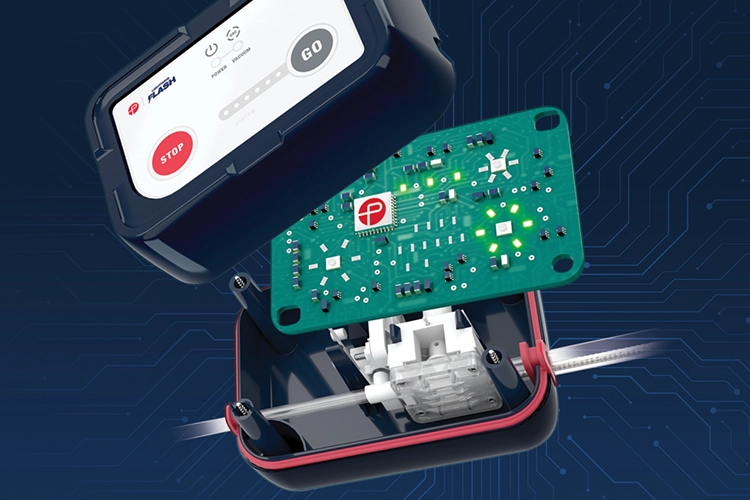
Treating pulmonary embolism (PE) is often a race against time. Physicians must balance the need for rapid intervention with procedural considerations that can affect both efficiency and patient outcomes. As mechanical thrombectomy continues to evolve, expectations on successful procedures are changing. Clinicians are looking for technologies supported by strong evidence, designed for procedural efficiency, and capable of simplifying treatment in high-acuity situations.
Computer Assisted Vacuum Thrombectomy (CAVT,®) technology is helping to redefine expectations. The landmark STORM-PE randomized controlled trial demonstrated that CAVT was superior to the current standard of care, anticoagulation alone, at reducing right heart strain for patients with acute intermediate-high risk PE.1 With that finding, Lightning Flash® became the only mechanical thrombectomy system backed by Level 1 evidence.*
Superior to Standard of Care, Comparable Safety
STORM-PE provides the strongest evidence to date for CAVT, demonstrating superior reduction in RV strain at 48 hours and better 90-day functional outcomes compared to anticoagulation alone for patients with acute intermediate-high-risk PE.1,7
The trial also reported zero device-related transfusions and zero access site complications, reinforcing the potential of mechanical thrombectomy to deliver effective clot removal without compromising procedural safety.1,a
Built for Speed, When It Matters Most
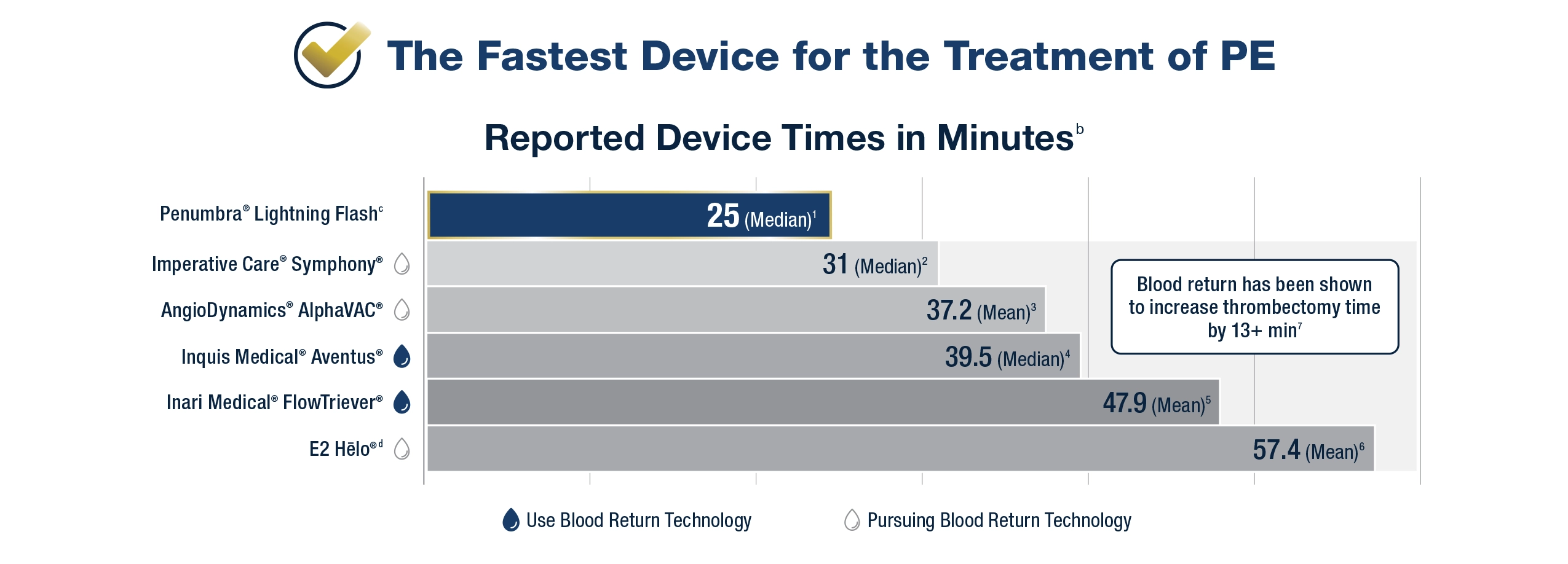
In PE treatment, efficiency is more than a workflow consideration. Every additional minute on the table represents a delay in meaningful restoration of pulmonary blood flow. In STORM-PE, Lightning Flash achieved a median device time of 25 minutes, the fastest reported among mechanical thrombectomy devices indicated for PE.1,b,c
Simplicity as a Clinical Advantage
CAVT is designed to simplify the procedure. Lightning Flash 3.0 uses clot-detection algorithms designed to optimize aspiration efficiency while minimizing estimated blood loss throughout the procedure. For interventional teams, that simplicity can support consistency, efficiency, and confidence during time-sensitive procedures.
Why Blood Return May Not Be the Answer
One of the most visible workflow additions for some thrombectomy systems is blood return technology, which filters and reinfuses aspirated blood back into the patient. While intended to address blood loss, multiple single-center experiences have not consistently demonstrated a clinical benefit.8,9,10
These findings raise an important consideration for clinicians evaluating thrombectomy platforms. If a technology can achieve efficient clot removal while minimizing estimated blood loss, is blood return necessary at all? CAVT technology focuses on targeted aspiration rather than additional workflow requirements.
Why CAVT Stands Alone
Clinical outcomes, procedural efficiency, and workflow considerations all play a role in selecting a treatment approach. CAVT is designed to address all three.
With Level 1 evidence demonstrating superiority to anticoagulation alone at reducing right heart strain for patients with acute intermediate-high risk PE,1 and a workflow designed to minimize blood loss, Lightning Flash delivers an advanced approach to PE intervention.
When minutes matter, physicians need more than clot removal alone. They need a system designed for speed, simplicity, and safety from start to finish.
Learn more about CAVT.
Important Safety Information
Additional information about Penumbra’s products can be located on Penumbra’s website at https://www.penumbrainc.com/products/peripheral-thrombectomy-cavt/. The clinical results presented herein are for informational purposes only and may not be predictive for all patients. Individual results may vary depending on patient-specific attributes and other factors. Caution: Federal (USA) law restricts these devices to sale by or on the order of a physician. Prior to use, please refer to the Instructions for Use (IFU) for complete product indications, contraindications, warnings, precautions, potential adverse events, and detailed instructions for use. For the complete Penumbra IFU Risk Summary Statements, visit: peninc.info/risk. Please contact your local Penumbra representative for more
information.
Copyright ©2026 Penumbra, Inc. All rights reserved. CAVT, Lightning Flash, and Penumbra are registered trademarks or trademarks of Penumbra, Inc. in the USA and other countries.
*As of September 2026.
1. Lookstein RA, Konstantinides SV, Weinberg I, et al. Randomized controlled trial of mechanical thrombectomy with anticoagulation versus anticoagulation alone for acute intermediate-high risk pulmonary embolism: primary outcomes from the STORM-PE trial. Circulation. 2026 Jan 6;153(1):21–34. doi:10.1161/CIRCULATIONAHA.125.077232. Median thrombectomy time 25 min.
2. Bangalore S, Tomalty RD, Kado H, et al. Prospective multicenter IDE study of the next-generation precision aspiration thrombectomy system for intermediate-risk pulmonary embolism: the SYMPHONY-PE trial. Circ Cardiovasc Interv. 2026 Nov;18(11):e015815. doi:10.1161/CIRCINTERVENTIONS.125.015815. Median device use-time of 31 min.
3. Keeling WB, Ranade M. Evaluating the safety and efficacy of the AlphaVac F1885 system in acute intermediate risk PE patients: APEX-AV trial. J Soc Cardiovasc Angiogr Interv. 2024;3(5)(suppl):101876. [Abstract LB-7] doi:10.1016/j.jscai.2024.101876. Mean Procedural time (device time) 37.2 min.
4. Sabri S, Horr S, Stegman B, et al; on behalf of the AVENTUS Trial Investigators. Novel aspiration thrombectomy and blood reinfusion system for acute intermediate-risk pulmonary embolism: AVENTUS trial results. J Soc Cardiovasc Angiogr Interv. 2025 May 2;4(7):103661. doi:10.1016/j.jscai.2025.103661. Median catheter dwell time of 39.5 min.
5. Jaber WA, Gonsalves CF, Stortecky S, et al. Large-bore mechanical thrombectomy versus catheter-directed thrombolysis in the management of intermediate-risk pulmonary thrombolysis in the management of intermediate-risk pulmonary embolism: Primary results of the PEERLESS randomized controlled trial. Circulation. 2025 Feb 4;151(5):260–273. doi:10.1161CIRCULATIONAHA.124.072364. Treatment catheter dwell time 47.9 min. (Mean).
6. Kobayashi T, Secemsky EA, Klein AJ, et al. A safety and feasibility single-arm study of a novel catheter thrombectomy device for the treatment of pulmonary embolism (ENGULF). J Soc Cardiovasc Angiogr Interv. 2024. May 3;3(6):102049. doi:10.1016/j.jscai.2024.102049. Mean procedure time from device insertion to removal was 57.4 min.
7. Presented by Lookstein R, on behalf of the STORM-PE Investigators. Randomized controlled trial of mechanical thrombectomy with anticoagulation versus anticoagulation alone for acute intermediate-high risk pulmonary embolism: 90-day functional outcomes from the STORM-PE trial. Presented at: Society of Interventional Radiology Annual Scientific Meeting; April 13, 2026; Vancouver, British Columbia, Canada.
8. Toma C. Impact of a blood return system on mechanical thrombectomy-associated blood loss and hemodynamic outcomes in a pulmonary embolism registry. European Heart Journal. 2022 Oct;43 (Suppl 2):ehac544.1893. doi:10.1093/eurheartj/ehac544.1893.
9. Bulman J. Blood quality and safety of autologous blood return using a continuous aspiration thrombectomy system for pulmonary embolism: bench and clinical evidence from the ENGULF Trial. Presented at: SIR (Society of Interventional Radiology) 2026; 13 April 2026; Toronto, ON, CA. 48-hour change.
10. Ahmed J. A comparison of post-procedural hemoglobin in catheter-directed thrombolysis vs. large-bore aspiration thrombectomy for acute pulmonary embolism. Paper presented at: SIR (Society of Interventional Radiologists) 2024; 23–28 March 2024; Salt Lake City, UT. Post-procedural change.
a. STORM-PE was powered for the primary efficacy endpoint only.
b. The definition of device time varies between studies. See citations and corresponding publications for specific definitions.
c. STORM-PE demonstrated a median device time of 25 minutes utilizing Lightning Flash 1.0 and 2.0.
d. Safety and feasibility single-arm study (n=25).
Related Articles
-
CIRSE 2026: New STRIKE-PE Analysis Shows Sustained Improvements in Functional Outcomes and Quality of Life One Year After CAVT Treatment
October 7, 2026 -
A Patient Was Told Her Pelvic Pain Was “Normal” for Years. It Wasn’t.
September 25, 2026 -
Employee Spotlight: Dillon Gedeon
September 23, 2026 -
How Complete Clot Ingestion May Reshape Aspiration Thrombectomy: Early Insights from THUNDER Investigators
September 10, 2026