
How Complete Clot Ingestion May Reshape Aspiration Thrombectomy: Early Insights from THUNDER Investigators
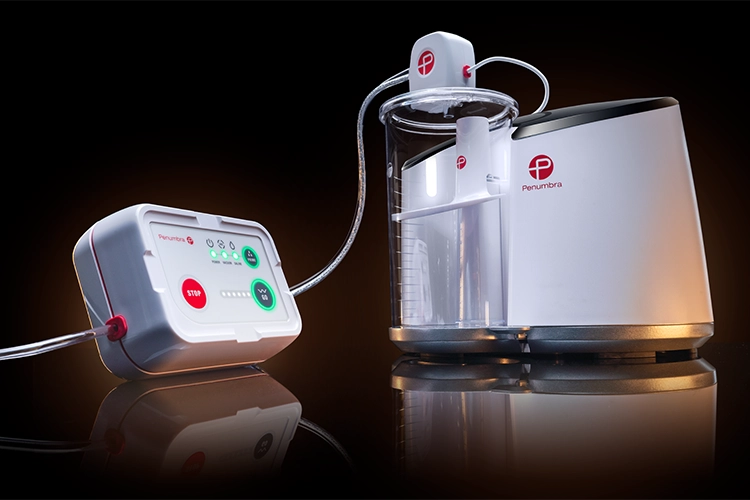
For clinicians treating acute ischemic stroke, every second matters. While aspiration thrombectomy has transformed stroke care by demonstrating overwhelming efficacy in preventing death and disability from large vessel occlusion (LVO),1 physicians continue to seek technologies that improve first-pass success and accelerate reperfusion. Results from the THUNDER Study suggest that Penumbra’s Computer Assisted Vacuum Thrombectomy (CAVT™) technology may represent an important advancement in faster, more complete clot removal.
THUNDER, an Investigational Device Exemption (IDE) study to evaluate the safety and efficacy of THUNDERBOLT®, was published this month in the Journal of NeuroInterventional Surgery.2 THUNDERBOLT is the first CAVT-powered aspiration system designed specifically for acute ischemic stroke. The CAVT technology is designed to detect, fatigue, and completely ingest clot at the site of the occlusion.
The investigators concluded that the THUNDERBOLT system achieved “high revascularization and clot ingestion rates, short procedure times, and low complication rates.”2
“In the THUNDER study, we observed that modulated aspiration facilitated consistent and complete clot removal when used in conjunction with standard-sized aspiration thrombectomy catheters,” said David Fiorella, MD, PhD, co-principal investigator of THUNDER and director of the Cerebrovascular Center at Stony Brook University Hospital, Stony Brook, NY. “Our early experience with THUNDERBOLT suggests that this technology could significantly advance treatment for stroke patients.”
Presented at SNIS by Dr. Fiorella, the study demonstrated strong procedural performance across several key measures.
Key Findings from the THUNDER Study:2
Reperfusion and First-Pass Performance
- THUNDER met its predefined performance goal, with 87.5% of cases achieving successful reperfusion, defined as mTICI 2b-3, post-THUNDERBOLT.
- Post-THUNDERBOLT, mTICI 2c-3 was achieved 70.4% of the time.
- First-pass mTICI 2b-3 was 64.8%.
Clot Removal
- Median time-to-revascularization was 20 min.
- Complete clot ingestion (CCI) was observed in 83.0% of cases where clot was visualized after the final pass.
Safety Profile
- Device/procedure-related serious adverse events (SAE) occurred in 2.8% of cases, sICH in 0.9%, and the rate of all-cause mortality at 90 days was 11.7%, which is comparatively low to other thrombectomy therapies. No SAE were attributed to Thunderbolt by the study sites.
“The ability to get the clot out efficiently in total the first time during your first pass is really the most important thing,” said Dr. Fiorella. “And when I look at gaps between technologies, that’s really the most differentiating factor is that first pass effect.”
A New Approach to Clot Removal
Typically, aspiration systems use either a syringe or continuous aspiration with a pump to remove a blood clot. Modulated aspiration enhances continuous aspiration by using CAVT technology to detect when the catheter has engaged the clot and then automatically varies the force being applied. The repeated stress applied to the clot helps weaken it, facilitating complete removal.
Importantly, with CAVT modulated aspiration and continuous aspiration are designed to work together rather than compete with one another. In the THUNDERBOLT system, modulated aspiration is used when the catheter engages the clot, and the system then automatically transitions to continuous aspiration once the clot has been removed or the modulation algorithm is completed. By combining both approaches, the goal is to make clot removal more efficient and help restore blood flow to the brain as quickly as possible.
“Complete clot ingestion or recovery during aspiration thrombectomy reduces the risk for distal emboli or emboli into an uninvolved territory,” said Dr. Fiorella. “In my opinion, it’s a much better form of aspiration thrombectomy than the typical plug and pull that we would see, where the clot would be lodged and the tip of the catheter and the entire catheter would have to be removed along with the clot, where there’s a risk of dislodgment.”
Procedural Efficiency Through First Pass Success
Dr. Frei and Fiorella note that one of the most important takeaways from the THUNDER study was the potential impact on procedural efficiency. “This modulated aspiration may substantially improve operators’ efficiency in regard to the ability to remove clot and to remove clot with their first pass,” said Dr. Fiorella.
First-pass success has long been a focus of stroke intervention because every additional pass can increase procedure complexity and extend the time before blood flow is restored. Technologies that can support clot ingestion on the first attempt may help physicians achieve faster and more consistent reperfusion.
“Penumbra’s modulated aspiration, in my opinion, represents an exponential leap in effectiveness of stroke thrombectomy,” said Donald Frei, MD, FSNIS, FACR, co-principal investigator and neurointerventional radiologist at Swedish Medical Center, Denver, CO.
Because neurological recovery is closely tied to how quickly blood flow is restored, technologies that enhance reperfusion efficiency may have meaningful implications for patient outcomes.
How CAVT Could Change the Future of Stroke Care
THUNDERBOLT represents the expansion of Penumbra’s CAVT platform into neurovascular care. THUNDERBOLT was designed by combining CAVT with the principles of science-based aspiration thrombectomy (S-BAT) to optimize aspiration and facilitate rapid, complete ingestion of large vessel occlusions.
While additional research will further define the role of CAVT in stroke intervention, the THUNDER study provides early evidence that modulated aspiration may enhance the speed, consistency, and completeness of clot removal.
Learn more about THUNDERBOLT.
Important Safety Information
Additional information about Penumbra’s products can be located on Penumbra’s website at https://www.penumbrainc.com/products/neuro-thrombectomy/. The clinical results presented herein are for informational purposes only and may not be predictive for all patients. Individual results may vary depending on patient-specific attributes and other factors. Caution: Federal (USA) law restrictions these devices to sale by or on the order of a physician. Prior to use, please refer to the Instructions for Use (IFU) for complete product indications, contraindications, warnings, precautions, potential adverse events, and detailed instructions for use. For the complete Penumbra IFU Risk Summary Statements, visit: peninc.info/risk. Please contact your local Penumbra representative for more
information.
Copyright ©2026 Penumbra, Inc. All rights reserved. CAVT and THUNDERBOLT are registered trademarks or trademarks of Penumbra, Inc. in the USA and other countries.
1. Goyal M, Menon BK, van Zwam WH, et al. Endovascular thrombectomy after large-vessel ischaemic stroke: a meta-analysis of individual patient data from five randomised trials. Lancet. 2016;387:1723-1731.
2. Fiorella D, Woodward K, Matouk C, et al. Thunderbolt System for acute ischemic stroke secondary to large vessel occlusion: primary results of the THUNDER study. Journal of NeuroInterventional Surgery Published Online First: 06 August 2026. doi: 10.1136/jnis-2026-025894
Related Articles
-
Young, Healthy, and at Risk: These Patient Stories Show Blood Clots Don’t Discriminate
October 12, 2026 -
CIRSE 2026: New STRIKE-PE Analysis Shows Sustained Improvements in Functional Outcomes and Quality of Life One Year After CAVT Treatment
October 7, 2026 -
A Patient Was Told Her Pelvic Pain Was “Normal” for Years. It Wasn’t.
September 25, 2026 -
Employee Spotlight: Dillon Gedeon
September 23, 2026