

NEURO
Hemorrhagic Stroke
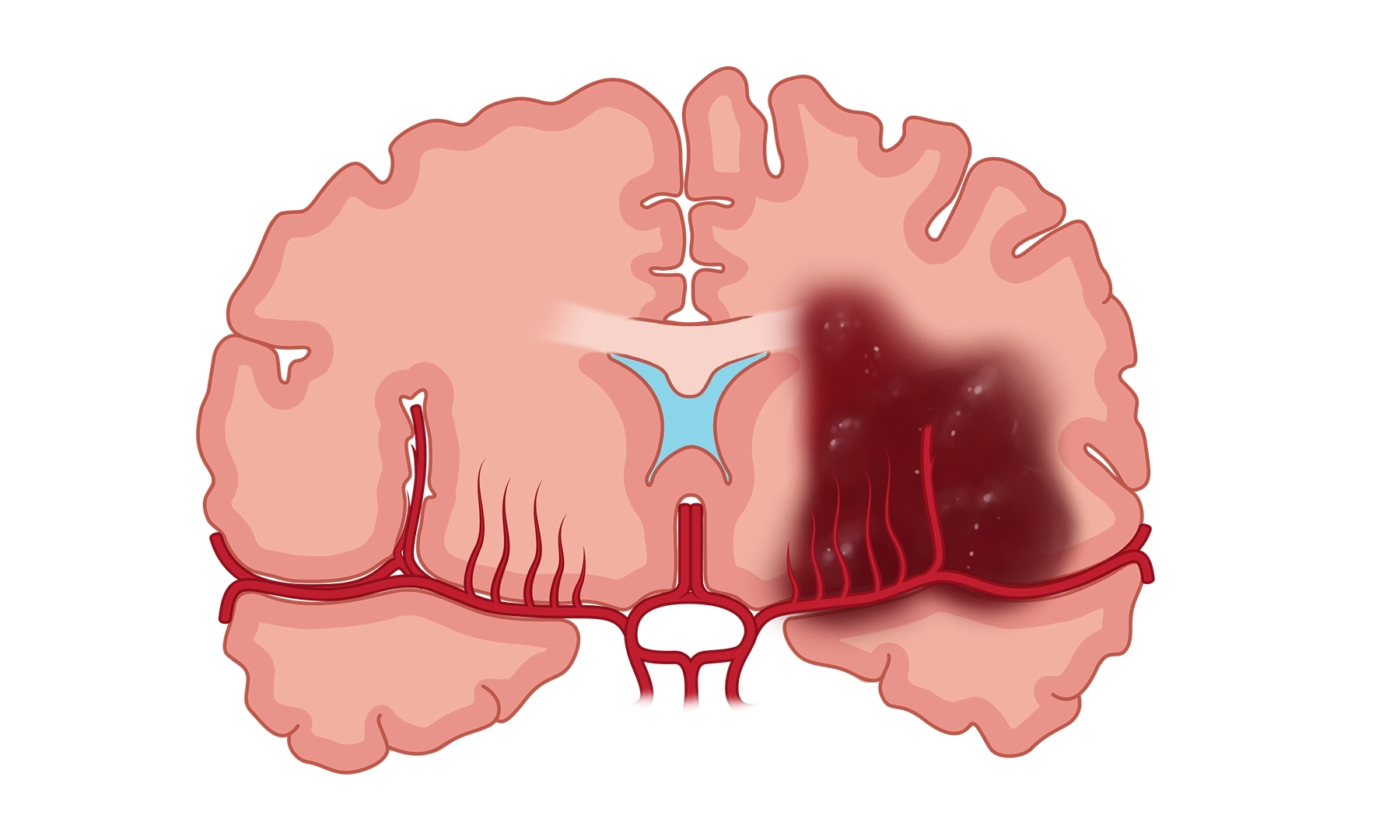
A hemorrhagic stroke is a serious medical condition that occurs when blood from damaged or ruptured blood vessels seeps into or around the brain. Intracranial bleeding disrupts the brain’s oxygen supply and upsets the chemical balance that brain cells need to function. The resulting blood clot (hematoma) can cause the brain to swell (edema) and increase intracranial pressure, which can cause further oxygen deprivation.
More About This Condition
A hemorrhagic stroke is one of two major stroke types. The other — called an ischemic stroke — is typically caused by an arterial blockage and is responsible for the majority of strokes. Both stroke types can cause lasting brain damage, long-term disability, and even death. However, early treatment can have a significant effect on outcomes. Therefore, it is critical to contact emergency services at the first sign of stroke.
Types of Hemorrhagic Stroke
- Intracerebral hemorrhage (ICH), the most common type of hemorrhagic stroke, occurs when a blood vessel in the brain leaks or ruptures (tears), allowing blood to seep into surrounding tissue. ICH has many causes, but it is most often the result of chronic high blood pressure.
- Subarachnoid hemorrhage (SAH) occurs when an artery located on the outer surface of the brain ruptures, allowing blood to leak into the fluid-filled space between the brain and the skull. The cause is often a ruptured cerebral aneurysm, a weakened area on an artery that bulges, fills with blood, and bursts open. The first sign of SAH is typically a severe headache that comes on suddenly with no known cause.
IMPORTANT NOTE: This overview is provided for informational purposes only and should not be used as a substitute for talking with your doctor. Be sure to talk with your doctor for a complete discussion of this condition as well as the benefits and risks of any treatment options.
Symptoms
Both types of hemorrhagic stroke (intracerebral and subarachnoid) can cause serious, sometimes fatal, complications. Hemorrhagic stroke symptoms can vary from person to person depending on the location and size of the bleed. The acronym BE FAST (Balance, Eyes, Face, Arm, Speech, Time) has been popularized in the United States and elsewhere to teach the telltale signs of stroke and the critical need to contact emergency services immediately. Difficulties with balance, blurred vision, face drooping, arm weakness, and speech difficulty are the outward signs that it’s time to call 911.
Symptoms typically appear suddenly and require immediate medical attention.
They can include:
- Sudden, severe headache
- Problems seeing in one or both eyes
- Dilated pupil
- Pain above or behind the eye
- Nausea and/or vomiting
- Stiff neck
- Sensitivity to light
- Seizures
- Loss of consciousness
- Paralysis or numbness of the face, arm, or leg
Diagnosis
Your doctor may:
- Ask you or your family member about your risk factors, such as high blood pressure, smoking, heart disease, and a personal or family history of stroke.
- Ask about your signs and symptoms and when they began.
- Conduct a physical examination.
Your doctor may order one or more of the following tests:
- Computed tomography (CT) scan involves the use of a special X-ray scanner and a computer to create many two-dimensional images, or “slices” of the brain that can be stacked to create a detailed picture. A similar process, called computed tomography angiography (CTA), involves the injection of a special dye, called contrast, via an IV into the bloodstream just prior to scanning. The dye allows doctors to see the blood and blood vessels within the brain tissue.
- Magnetic resonance imaging (MRI) uses computer-generated radio waves and a magnetic field to create two- and three-dimensional detailed images of the brain. Like a CTA, MRA (Magnetic Resonance Angiogram) can provide detailed images of brain vessels but can accomplish this with or without the use of contrast.
- Cerebral angiography involves an injection of contrast dye into the neck and brain arteries. The dye is injected via a catheter, a long tube-like device that is inserted into a leg or arm artery and slowly threaded through the body up to the neck. The dye helps create a detailed image of the arteries on an X-ray in two or three dimensions.
- Cerebrospinal fluid (CSF) analysis measures chemicals in the fluid that cushions the brain and spinal cord. Most often a small amount of cerebrospinal fluid is collected by inserting a thin needle into the spinal cord in the area of the lower back. Additional testing may be needed if test samples indicate bleeding around the brain.
Treatment
Treatment for this condition must always be discussed with your doctor for a full discussion of options, risks, benefits, and other information.
Hemorrhagic stroke is a serious medical condition associated with a high risk of disability and death. It is important to contact emergency services immediately to determine the cause of the bleeding and begin medical treatment.
Treatment options may include the following:
Medical Management can include, but is not limited to, the management of:
- Temperature
- Nutrients/fluids
- Breathing
- Blood pressure
- Intracranial pressure
Surgery
- Decompressive Craniectomy is when a piece of skull is removed to relieve pressure on the swollen brain. Craniectomy with evacuation is when a piece of skull is removed so that a neurosurgeon can eliminate pooled blood from the affected area.
- Endovascular embolization is the primary endovascular procedure used to treat both unruptured and ruptured brain aneurysms. A minimally invasive treatment, embolization blocks blood flow to problem areas. To reach an aneurysm, a catheter (tube) is inserted through an incision in the femoral artery at the groin and guided towards the brain. Fluoroscopy (a type of X-ray) is used to track the catheter through the arteries. Once in position, soft platinum metal coils are pushed through the tube and released into the enlarged space. The coils mechanically occlude (block) the space and induce clotting (embolization) to cut off blood flow to the affected site. Coils are very small and thin, ranging in size from about twice the width of a human hair (largest) to less than one hair’s width (smallest). The number of coils used depends on the size of the lesion.
- Surgical clipping is an open surgical procedure in which blood flow to an aneurysm is cut off by placing a clip at its base.
Questions?
Contact us to learn more about our products and company