
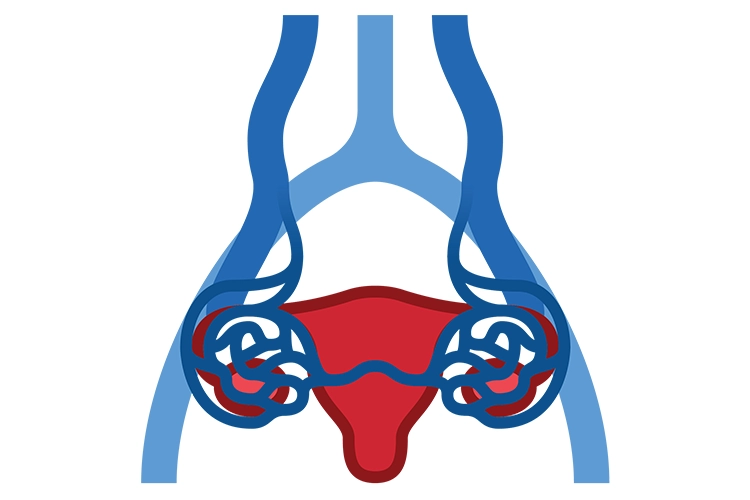
Pelvic venous disease (PeVD) is an underrecognized but significant contributor to chronic pelvic pain in women, often leading to years of frustration, misdiagnosis, and ineffective treatment. As clinicians work to better understand the complex interplay of pelvic venous anatomy, reflux, and symptom patterns, renewed focus has emerged on accurately identifying venous-origin chronic pelvic pain (VO-CPP) and directing patients toward effective, minimally invasive options.
This Q&A, originally published in Endovascular Today, includes responses from Dr. Gloria Salazar, MD, FSIR, Associate Professor at the UNC School of Medicine in Chapel Hill, North Carolinai, and Dr. Ronald Winokur, MD, FSIR, RPVI, Professor of Radiology at Weill Cornell Medicine in New Yorki explore the latest in PeVD care and the potential of the ongoing EMBOLIZE randomized controlled trial to address critical gaps in evidence, improve diagnostic pathways, and expand access to care for patients worldwide.
Q: A lot has been discussed around PeVD. How do we take on and resolve vein-related pelvic pain in women?
PeVD has been associated with VO-CPP, but it is often overlooked because it’s hard to diagnose, leading to significant effects on patients’ lives. In these situations, female pelvic pain must be well assessed by evaluating for pelvic, periuterine, and/or periovarian varicose veins, along with dilation and retrograde flow in the ovarian veins. Identification of venous insufficiency as well as pelvic varices in the periuterine and periovarian spaces may allow for targeted treatment and optimal patient management.
Q: How should you consider treatment for PeVD?
Treatment should be based on predominant symptoms and anatomic abnormalities (compression and/or reflux) in the left renal and pelvic veins. In patients with VO-CPP alone (S2 disease), it is important to optimize the workup to identify pelvic venous dilation and reflux. Regarding S2 symptoms (VO-CPP), the EMBOLIZE trial is currently active in evaluating outcomes of ovarian vein embolization in patients with periuterine and/or periovarian varices resulting from ovarian vein reflux.
Q: How should women with suspected PeVD be assessed so they are clearly directed for treatment and symptom improvement?
Pelvic imaging utilizing CT, MRI, and ultrasound can be highly beneficial by identifying pelvic varices and connected networks with dilation and/or reflux. If other solutions have been attempted to resolve pelvic pain, imaging of the pelvis to identify varicosities and the source of pelvic venous hypertension are important to best determine treatment.
Q: How can diagnosis be optimized to prevent misdiagnosis from guiding suboptimal patient care?
Often, patients will have many assessments by other specialists, leading to a high incidence of potential hysterectomy and/or oophorectomy. Unfortunately, this does not always help patients, as it does not always lead to pelvic varix identification, which can be treated and eliminated to improve symptoms.
Q: How is women’s health affected by VO-CPP, and what are the broad impacts on women’s health and professional function?
At an individual level, the inability to diagnose a condition leaves patients and their physicians frustrated. Suggestions that their problems are purely psychological alienate women, who may seek advice from multiple doctors or withdraw from further evaluation despite persistent symptoms. Unnecessary or ineffective treatments, including surgery, further contribute to their frustration. In addition, VO-CPP affects women’s personal and professional lives, impairing their quality of life significantly. At a global level, it is estimated that PeVD affects at least one-third of women with CPP, but due to the lack of high-quality data — even when patients are properly diagnosed — insurance companies do not cover the procedure in many countries around the world. Because of limited data demonstrating the effectiveness of intervention, randomized controlled trials have not previously been conducted; however, results from the EMBOLIZE trial may provide much-needed critical data.
Q: Insurance coverage has strongly affected many patients. Could EMBOLIZE study outcomes help address this coverage gap?
It is extremely challenging and unfortunate that coverage is limited for ovarian venography and embolization, leading to barriers for patient access to therapeutic options. Unfortunately, this might lead to self-pay care by patients, which is not achievable for all. The outcomes of the EMBOLIZE study may provide valuable data to help address the insurance coverage gap.
Q: Why is EMBOLIZE unique?
EMBOLIZE is a prospective randomized controlled trial of venography with bilateral ovarian vein embolization and pelvic venous embolization or venography alone (sham procedure). Patients enrolled will be blinded to the procedure performed, leading to high-quality outcome data showing the results of embolization over time in patients with true VO-CPP. In addition, the study design has very strict patient selection criteria, an appropriate comparator (venography alone), and mitigates biases by adopting blinded assessors for data collection and clinical evaluation of patients after randomization.
Q: What outcomes and data will be collected within EMBOLIZE?
The EMBOLIZE trial is designed to evaluate the change in patient’s PeVD-related pain before and after their assigned treatment using the visual analog scale. Pain assessments are collected weekly during the baseline period and after the index procedure. Because visual analog score is not disease-specific, it has been determined to be ideal for pain score assessment in this patient population. The study will also allow for assessment of disease-specific criteria such as the PROMIS (Patient-Reported Outcomes Measurement Information System) scale, PGIC (Patient Global Impression of Change), and EQ-5D.
Q: What’s next after EMBOLIZE? Will there be follow-up for these patients?
EMBOLIZE trial patients will be followed for 6 months after randomized intervention and/or venography as part of the research trial. At 6 months, crossover will be allowed for patients who were randomized to control with venography alone, and critically important data will continue to be released on outcomes after embolization. Long-term data in this patient population may create great understanding and guide additional treatment needs.
Q: What can physicians do right now to help their patients get treated?
First, knowledge of VO-CPP as a potential diagnosis for noncyclic pelvic pain — particularly when it worsens with prolonged standing and improves with lying flat (postural pain) as well as postcoital pain — should raise suspicion. Second, when VO-CPP is suspected, patients should be referred to the appropriate specialists. They undergo multiple medical evaluations and workups, but they often don’t have access to vascular interventionalists. This leads to delays in care, personal frustration, increased disease burden, and reduced quality of life. Finally, before proceeding with intervention, a thorough anatomic and symptom evaluation is crucial. Understanding the patient’s full pelvic venous anatomy and the specific symptom pattern improves outcomes. Pelvic embolization alone is effective when there is no venous compression.
The EMBOLIZE trial may help determine the central importance and frequency of VO-CPP that can be eliminated in low risk and high success rate pathways.
Learn more about the EMBOLIZE Trial.
Important Safety Information
Additional information about Penumbra’s products can be located on Penumbra’s website at https://www.penumbrainc.com/products/peripheral-embolization/. Caution: Federal (USA) law restricts these devices to sale by or on the order of a physician. Prior to use, please refer to Instructions for Use for complete product indications, contraindications, warnings, precautions, potential adverse events, and detailed instructions for use. Risk information can be found at peninc.info/risk. Please contact your local Penumbra representative for more information.
The clinical results presented herein are for informational purposes only, and may not be predictive for all patients. Individual results may vary depending on patient-specific attributes and other factors.
i. Disclosures: Speaker for Penumbra, Inc.
This Q&A originally appeared in the February 2026 issue of Endovascular Today.