
Why This Big Red Bus Is Bringing Blood Clot Awareness to Communities Across Mississippi
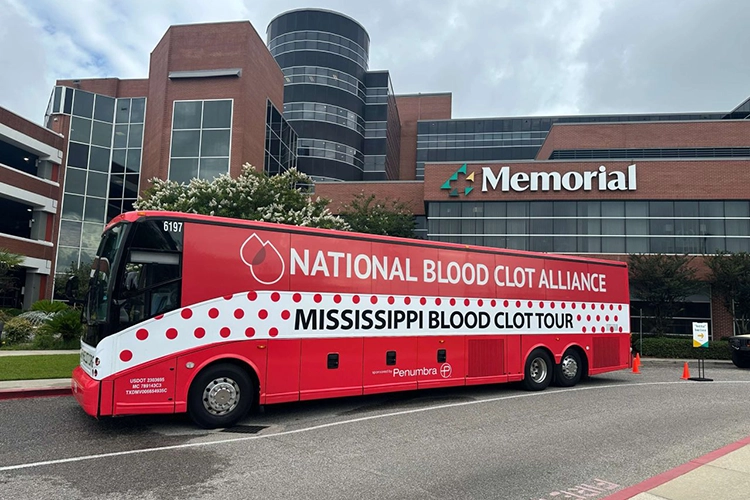
In Mississippi, where access to care can mean hours of travel, a life-threatening blood clot may go unrecognized until it’s too late. This spring, a big red bus set out to change that.
Blood clots are one of the most urgent — and overlooked — health threats in the U.S., contributing to as many as 900,000 cases each year and up to 100,000 deaths.1 In Mississippi, that risk is amplified by systemic gaps in healthcare access, and disproportionately high rates of chronic conditions that increase clotting risk.
To confront these challenges, Penumbra partnered with the National Blood Clot Alliance (NBCA) to launch the Mississippi Blood Clot Awareness Bus Tour — an initiative designed to bring life‑saving education directly into underserved communities. The tour aims to close critical gaps in access, equity, and prevention by helping people recognize symptoms early, understand their personal risk, and feel empowered to seek care. The effort underscores a simple but powerful idea: when healthcare systems fall short, education can become a lifeline.
“It’s important for people to recognize the signs and symptoms of blood clots because they can be life-threatening,” said Shruthi Narayan, president of Penumbra. “By partnering with NBCA on this blood clot awareness bus tour, we want to educate as many people as we can, especially in regions such as Mississippi where systemic barriers to care may exist, so they know when to get help right away and what treatment options are available. The more people know what to watch out for, the better the outcomes are.”
Despite being the third leading cause of cardiovascular death and the leading cause of preventable death among hospital patients, public awareness around blood clots remains low and misconceptions persist. The bus tour is designed to help close that gap by delivering clear, actionable information directly to communities, emphasizing that anyone can develop a clot and that early recognition and prevention are critical.
“It’s important to get information into the hands of people where they live, where they worship, where they work. Nothing replaces boots on the ground in terms of providing people with material about blood clot prevention, education, and awareness,” said Leslie Lake, volunteer president of the NBCA.
NBCA’s Big Red Bus Brings Education to Communities Across Mississippi
In May, the NBCA’s “Big Red Bus” traveled across the state from the capital, Jackson, out west to Greenville, north to Charleston and Oxford, east to Columbus, and south to Gulf Coast communities. The tour brought together health care providers, advocates, and blood clot survivors who shared stories of their battles with blood clots.
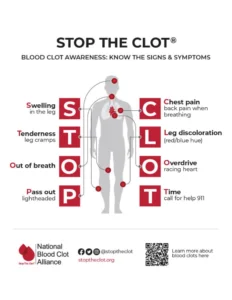
At each stop, community members gathered in church halls, hospital conference rooms, and local centers — listening to clinicians break down risk factors and the latest treatment options, flipping through patient guides, and even getting screened. At each stop, NBCA volunteers shared the STOP CLOT acronym to help people recognize the signs and symptoms of blood clots.
“I’d like people to educate themselves about blood clots and the signs and symptoms,” said Antoine Rizk, MD, FACC, FSCAI, a cardiologist at Memorial Hospital in Gulfport, where he joined a panel the bus tour hosted. “Blood clots kill, so you need to really learn and familiarize yourself with that illness, which we often refer to as a silent killer.”
Dr. Rizk spoke about recent innovations in blood clot care. “There have been tremendous advancements in blood clot care.” He detailed new medications and protocols that have been put in place to lower the risk of bleeding. “And finally, we have technologies where we can safely mechanically extract blood clots from the lungs, from different lobes, and fix the problem.”
But the key to these new innovations is early detection. “The earlier you show up for care, the more likely you are to have a successful outcome,” said Dr. Rizk.
Patient Advocates Share Their Stories
Perhaps the most impactful moments of the bus tour involved listening to the patient advocates, or “Thrombassadors,” share their experiences with blood clots. These stories highlight how understanding the risks and advocating for yourself can help improve outcomes and even save your life.
Karen’s Story
Karen D. Adams from North Carolina, began experiencing blood clots during an already difficult battle with cancer — a journey that revealed just how much she, like many patients, didn’t fully understand the risks she faced.
During her treatment for colon cancer, multiple threats converged. “There were two risk factors that I wasn’t aware of,” Karen recalls. The first was a bleeding risk from her chemotherapy, and the other was a blood clot risk from a medication she’d been taking since battling breast cancer years earlier. Karen ended up having two blood transfusions after chemo. While hospitalized and confined to bed for a week, Karen received inconsistent leg compression, a precaution to help prevent blood clots.
“Because of my lack of knowledge of the things that I should be asking for, I didn’t know. I just accepted it,” she reflects.
Back home, Karen tried to make breakfast for her kids. Within minutes, something felt wrong. “My body was so weak and so heavy, I couldn’t even scramble the eggs,” she remembers. Within hours, she was struggling to breathe and nearly collapsed.
Acting on instinct, she called her husband and insisted on going to the ER — an action she believes saved her life.
She was diagnosed with a saddle pulmonary embolism, “a big blood clot that covers both lungs.” Karen now connects the dots between her immobility, treatment risks, and missed preventative measures: “All of that ended up with me having a blood clot.”
Looking back, Karen sees what she couldn’t before: the risks, the warning signs, and the moments where she could have spoken up. “I wish I would have known to advocate for myself and say, no, I need you to put these compressions back on my legs,” she says.
Above all, Karen wants people to understand that blood clots can affect anyone — and that awareness can save lives. “Anybody can get a blood clot. It doesn’t matter your age, your size, your color, or anything. Anyone can get it,” she says. “Know the signs, know your risk factors, and advocate to save a life, starting with yours.”
Lisa’s Story
“I was diagnosed at 25 years old,” recalls Lisa Lane, a nurse from Tennessee. “At the time I was five months pregnant with my only child.” Just a few years earlier, she had been a Division I college basketball player — healthy, active, and seemingly low risk. But when symptoms began, they were repeatedly misread. “I was misdiagnosed with sciatica, with edema in the legs, also a kidney infection.”
Many of the signs were dismissed because they mirrored pregnancy-related symptoms, a fairly common occurrence for blood clot patients. It wasn’t until “two weeks later, when they did the Doppler, they confirmed the [deep vein thrombosis] (DVT) in my left leg,” finally giving a name to what she had been experiencing.
Lisa struggled to find a medication that would work and experienced 17 DVTs and an arterial clot in her heart over the years that followed. Eventually Lisa found a specialist who correctly diagnosed her with a clotting disorder and resistance to anticoagulants. He helped develop a management regimen that has kept her clot-free for five years.
For Lisa, sharing her story is about ensuring others recognize the warning signs sooner than she did, and take action. “If something doesn’t feel right, keep going, keep pushing, keep advocating. Unfortunately, sometimes we have to be our own best advocate,” said Lisa. “It could save your life.”
From Awareness to Action: Why This Work Matters
The Mississippi bus tour won’t solve every gap in care. But it brings something critical directly into communities: knowledge, trust, and the confidence to act. And when it comes to blood clots, that awareness can be the difference between life and death.
It’s a very personal mission for all involved. Leslie Lake, for example, is not just the volunteer president of the NBCA who led the bus tour, she’s also a blood clot survivor who suffered a pulmonary embolism (PE).
“Prior to my blood clot experience, I didn’t know what it was,” she said. “And then once I did have my PE and I started to learn more, I was shocked at how many people get this. I was shocked at how many people die from this. And I was shocked that this is highly, highly preventable, particularly in a hospital setting or post-hospitalization setting. It has really been the catalyst for me to get involved with this incredible organization to spread awareness, because awareness is key, and it saves lives.”
1. Centers for Disease Control and Prevention. (2023, June). Impact of Blood Clots on the United States Infographic. National Center on Birth Defects and Developmental Disabilities (NCBDDD). Accessed May 11, 2026.
Related Articles
-
What Should Physicians Expect from the Next Generation of Mechanical Thrombectomy Technology?
September 21, 2026 -
How Complete Clot Ingestion May Reshape Aspiration Thrombectomy: Early Insights from THUNDER Investigators
September 10, 2026 -
Penumbra Launches Link, Expanding Vascular Thrombectomy Options for Physicians
September 9, 2026 -
Employee Spotlight: Olina Islam
August 25, 2026