
Case Series: Penumbra’s SwiftPAC Coil Found to Be Versatile and Reliable
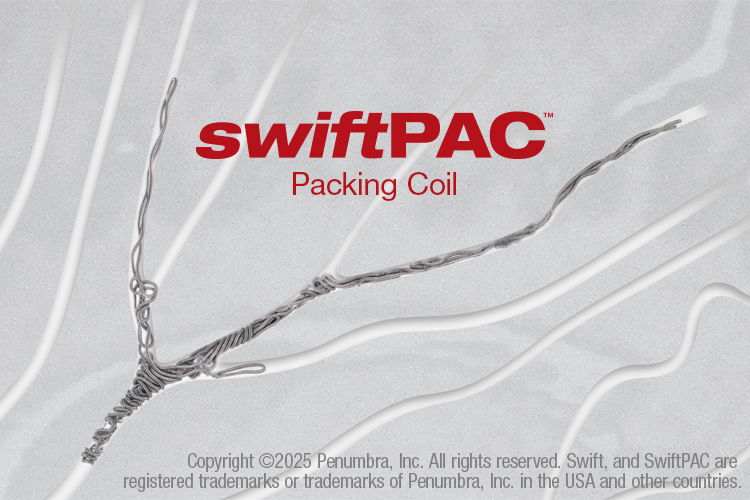
A recent analysis of a small cohort of patients across a range of pathologies found that the Penumbra SwiftPAC™ coil provided “rapid and reliable vessel occlusion while minimizing complications.” The case series was published in the journal Interventional Neuroradiology.
The researchers, led by Nicolas Khattar, MD, a neurosurgeon at the Semmes Murphey Clinic at the University of Tennessee Health Science Center in Memphis, analyzed 18 consecutive patients embolized with SwiftPAC across diverse neurovascular conditions, including “post-traumatic vessel sacrifices, preoperative embolization for tumors, severe epistaxis, temporo-mandibular joint (TMJ) dysfunction, acute and chronic subdural hematomas, direct carotid-cavernous fistula, aneurysm recurrence, and oropharyngeal hemorrhage.”
Every case achieved complete occlusion of the target vessel with one exception, which was complicated by significant vasospasm preventing coil deployment. An average of seven coils were used per patient, ranging from one coil to 22. No complications were observed. The authors concluded that SwiftPAC is “a versatile tool in the neurointerventionalist’s armamentarium.”
While the research is illustrative in nature, the authors highlighted several benefits of the SwiftPAC technology, including:
- Distal Coil Navigation – “The 2D wave design enables the coil to navigate distally in a vessel until it encounters resistance,” the authors wrote. This is “particularly beneficial when the anatomy is highly tortuous, preventing the microcatheter from reaching distal areas.”
- Coil Variety – “A unique advantage of the SwiftPAC coil system is its wide range of available sizes (3–60 cm), significantly reducing the number of coils needed for embolization,” wrote the authors.
- Potential for Reduced Procedure Time – “Rapid completion of the procedure improves safety, enhances outcomes, and reduces overall costs,” noted the authors.
Penumbra’s SwiftPAC coils are designed as a soft space-seeking “liquid metal” that conforms to the target vessel for dense packing. These attributes are designed to provide versatility across a variety of clinical applications. Penumbra recently expanded the product offering to include 20 cm and 25 cm coils.
The authors note that the “2D wave-like coil design allows for better conformation of the coil to the space since there is no tertiary structure, thereby allowing for improved packing density.” Its innovative 2D sinusoidal shape is designed to help the coil break effortlessly to seek empty space. With a softness value of .093, SwiftPAC is engineered to be one of the softest 10-system coils on the market.
Important Safety Information
Additional information about Penumbra’s products can be located on Penumbra’s website at https://www.penumbrainc.com/products/neuro-embolization-system/. The clinical results presented herein are for informational purposes only, and may not be predictive for all patients. Individual results may vary depending on patient-specific attributes and other factors. Product availability varies by country. Caution: Federal (USA) law restricts these devices to sale by or on the order of a physician. Prior to use, please refer to Instructions for Use (IFU) for complete product indications, contraindications, warnings, precautions, potential adverse events, and detailed instructions for use. For the complete Penumbra IFU Summary Statements, visit: peninc.info/risk. Please contact your local Penumbra representative for more information.
Copyright ©2025 Penumbra, Inc. All rights reserved. Swift and SwiftPAC are registered trademarks or trademarks of Penumbra, Inc. in the USA and other countries.
Related Articles
-
Penumbra Presents Results for STORM-PE and STRIKE-PE, Adding to a Growing Body of Evidence Backing CAVT
March 24, 2026 -
Case Study: Next-Generation Lightning Flash 3.0 Efficiently Clears Right-Sided PE and Lower Extremity Venous Thrombus
March 5, 2026 -
EVT Panel Discussion: Expert Perspectives on the Modern PE Landscape
March 2, 2026 -
Employee Spotlight: Mary Karam
February 25, 2026