
Case Study: Next-Generation Lightning Flash 3.0 Efficiently Clears Right-Sided PE and Lower Extremity Venous Thrombus

Dr. Clay Wiske, MD, a vascular surgeon at Stanford Health in Pleasanton, California, shares a case in which he used the Lightning Flash® 3.0 to remove thrombus from a female patient in her early 70s suffering from a pulmonary embolism (PE). Dr. Wiske then used the same device to successfully restore patency to the left iliac vein.
The latest Lightning Flash 3.0 technology includes upgrades designed to increase clot removal speed and fluid savings. The trackability of Penumbra’s comprehensive VTE platform facilitated efficient navigation to the right pulmonary artery as well as seamless access up-and-over the iliocaval confluence. This up-and-over approach provides the ability to remove thrombus present in the inflow vessels, helping to positively impact long-term patency. Additionally, this system successfully delivered clot removal therapy in a patient with active cancer, an often underserved population from a thrombectomy standpoint. Dr. Wiske’s case, below, was originally published in Endovascular Today.
Patient Presentation
A woman in her early 70s with a relevant history of uterine carcinoma on immunotherapy with left iliac vein compression presented to the emergency depart¬ment with shortness of breath and severe pain, swell¬ing, discoloration, and numbness of the left leg. She was progressively hypoxic and hypotensive and was intubated and started on multiple pressors.
A CT scan demonstrated thrombus in the right pul¬monary artery (PA) and extensive thrombus of the left lower extremity extending from the compressed left iliac vein inferiorly throughout the left lower extremity venous system. Her physical examination was consistent with phlegmasia with high-resistance signals in the left foot compared to palpable pulses in the right foot.
The patient’s family felt that it would be consistent with the patient’s wishes to proceed with intervention. We discussed interventions for both the PE and the acutely threatened left lower extremity.
Given the concern for massive PE, as well as an acutely threatened limb, an approach was taken that would provide the best probability of survival and thus the best probability of rapidly addressing the right PA thrombus. As a secondary goal, because the left leg was acutely threatened, an approach that would potentially facilitate left leg thrombectomy in a rapid fashion was favored.
Intervention
Bilateral common femoral vein access was obtained. The right-sided access was primarily used to facilitate thrombectomy, and the left-sided access was obtained to provide a rail for up-and-over sheath and catheter advancement in anticipation of potential lower extremity thrombectomy. A 17-F, 65-cm Element™ sheath was advanced into the right PA, and a right-sided thrombus affecting multiple segmental branches was identified. The 16-F Lightning Flash 3.0 catheter was advanced over a Rosen wire into the right PA, and aspiration was turned on; near-immediate evacuation of the target thrombus was achieved and confirmed by follow-up angiography. Following successful pulmonary thrombectomy, a decrease in PA pressure was noted.
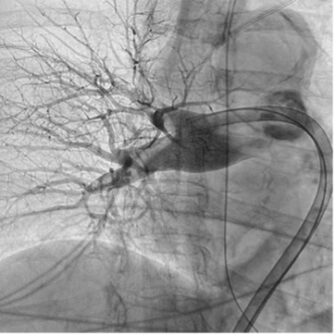
Pre—Angiogram showing right-sided pulmonary thrombus.
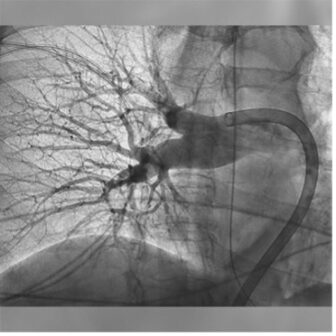
Post—Follow-up angiogram showing target pulmonary thrombus removed after thrombectomy.
The focus was shifted to the left leg. A 0.035-inch guidewire was snared for through-and-through up-and-over access. The same Lightning Flash 3.0 was reintroduced and advanced across the iliocaval confluence. Thrombectomy of the left iliac system was successful. The through-and-through wire was removed such that left vein thrombectomy could be performed as well. After three passes, a significant amount of thrombus was removed. Final angiography demonstrated restored patency after placement of an Abre™ stent (Medtronic).
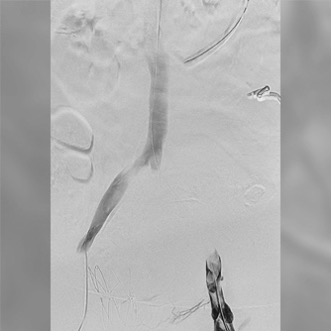
Pre—Angiogram of the left iliac system shows significant thrombus.
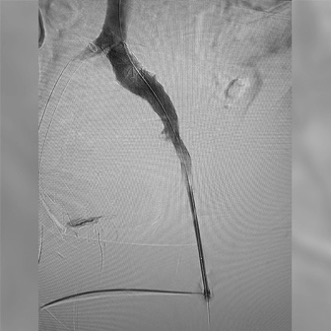
Post—Angiogram shows restored patency after thrombectomy.
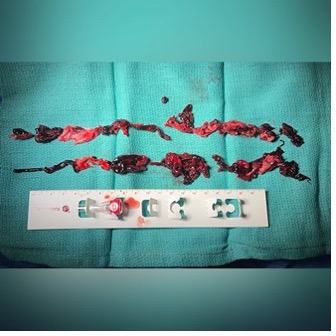
Clot—Left lower extremity venous thrombus extracted.
Discussion
The upgraded Lightning Flash 3.0 clot detection algorithm was notable for enhancing sensitivity to blood and thrombus and enabled a single-session thrombectomy for pulmonary and venous thrombus with mitigated estimated blood loss and avoidance of tissue plasminogen activator. Additionally, the trackability of Penumbra’s comprehensive VTE platform facilitated efficient navigation through complex and variable patient anatomy.
Important Safety Information
Additional information about Penumbra’s CAVT products can be located on Penumbra’s website at https://www.penumbrainc.com/products/peripheral-thrombectomy-cavt/. Caution: Federal (USA) law restricts these devices to sale by or on the order of a physician. Prior to use, please refer to Instructions for Use for complete product indications, contraindications, warnings, precautions, potential adverse events, and detailed instructions for use. Risk information can be found at peninc.info/risk. Please contact your local Penumbra representative for more information.
Images used with permission. Consent on file at Penumbra, Inc. Procedural and operative techniques and considerations are illustrative examples from physician experience. Physicians’ treatment and technique decisions will vary based on their medical judgment. The clinical results presented herein are for informational purposes only, and may not be predictive for all patients. Individual results may vary depending on patient-specific attributes and other factors.
Copyright ©2026 Penumbra, Inc. All rights reserved. Lightning Flash and ELEMENT are registered trademarks or trademarks of Penumbra, Inc. in the USA and other countries. All other trademarks are the property of their respective owners.
Related Articles
-
Penumbra Presents Results for STORM-PE and STRIKE-PE, Adding to a Growing Body of Evidence Backing CAVT
March 24, 2026 -
EVT Panel Discussion: Expert Perspectives on the Modern PE Landscape
March 2, 2026 -
Employee Spotlight: Mary Karam
February 25, 2026 -
Employee Spotlight: Juliana Monela Teter
January 28, 2026